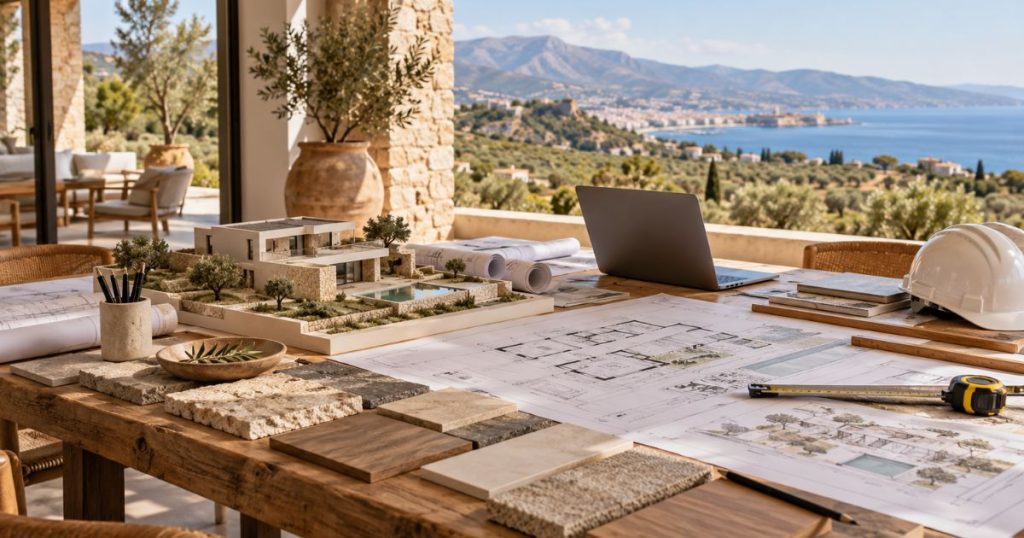
How do you choose the right construction company? Here is what to check before you award the construction or renovation of a property in Crete.
Choosing the right construction company is one of the most important decisions before building or renovating a property.
Whether it is a new home, a holiday or tourist property, or the renovation of an existing building, the company that takes on the project directly affects the quality of construction, the organisation of the work, keeping to the budget and the owner’s whole experience.
In Rethymno and across Crete, where many projects combine plots with demanding landforms, local architectural features and higher requirements because of tourist use, choosing the right partner matters even more.
So how can you assess a construction company before trusting it with your project?
1. Look at its experience and past projects
The first step is to look at what kind of projects the company has already completed.
Don’t look only at how many years it has been in business. What matters more is whether it has real experience in projects like the one you are planning.
If, for example, you want to build a modern home in Rethymno, it is useful to see detached houses, villas or holiday homes it has built before.
Look at:
- the quality of the finishes,
- the architectural approach,
- the range of projects,
- the solutions used,
- the quality of the landscaping.
A well-organised portfolio can give you a first idea of the company’s philosophy and standard of construction.
2. Don’t choose on the lowest price alone
Price is obviously an important factor, but it shouldn’t be the only criterion.
Two quotations may seem to cover the same project, when in reality they include different materials, a different quality of work or a different scope of services.
A significantly lower quotation is worth examining in detail.
The right question is not only “How much does it cost?”, but “What exactly does this price include?”
That is why you should ask for as detailed a description of the scope of the project as possible.
3. Ask for a detailed technical proposal
A proper construction quotation should be detailed enough for the owner to know what is included and what is not.
Ideally, it should set out the main categories of work, the materials provided for and the technical specifications.
For example:
- earthworks,
- concrete and load-bearing structure,
- masonry,
- thermal insulation,
- waterproofing,
- electrical and plumbing installations,
- windows and doors,
- flooring and tiling,
- painting,
- landscaping.
The clearer the quotation is before the project starts, the less room there is for misunderstandings later.
4. Check who will actually supervise the project
An important question is who will be on site every day or regularly.
Good construction doesn’t depend only on the drawings. It depends to a great extent on carrying them out properly.
Ask:
- who is in charge of the project,
- who coordinates the trades,
- how technical supervision is carried out,
- how often the site is inspected,
- who is the owner’s main point of contact.
Having one clearly responsible person can make a significant difference to how construction is coordinated.
5. See whether there is an organised team of engineers and trades
Building a house requires many different specialists to work together.
Architects, civil engineers, mechanical engineers, electricians, plumbers and different technical crews must work in coordination.
A well-organised construction company in Rethymno must be able to coordinate both the design and the construction of the project effectively.
Good coordination reduces delays, limits mistakes and helps the different phases of construction follow the right order.
6. Assess how they communicate
Building a home is a process that takes a long time and involves many decisions.
That is why communication with the company is just as important as its technical expertise.
From the first meetings, notice:
- whether they answer your questions clearly,
- whether they explain the technical choices,
- whether they tell you about possible difficulties,
- whether they avoid unrealistic promises,
- whether there is a set way of keeping you informed about progress.
A good collaboration is based on transparency, not on the promise that “everything will be done”.
7. Ask how changes during construction are handled
Almost every project can involve changes.
The owner may decide on a different material, change an interior layout or ask for additional work.
What matters is that there is a clear procedure agreed in advance.
Ask how:
- additional work is approved,
- changes are costed,
- the owner is informed,
- the schedule is affected.
This avoids financial surprises towards the end of the project.
8. Look at the schedule
An organised construction company should be able to present a realistic schedule of works.
Not every date needs to be treated as fixed, as there may be delays because of weather, supplies, approvals or changes.
However, there should be a clear plan showing the main stages:
- start of works,
- load-bearing structure,
- masonry,
- installations,
- finishes,
- landscaping,
- completion and handover.
The schedule is a key coordination tool, not just an estimate of the handover date.
9. Check the company’s professional standing
Before awarding a major project, it is reasonable to check the company’s basic details too.
Make sure you know which company or professional entity will sign the contract with you, and that these details are the same as those on the agreements, quotations and invoices.
Professional transparency is particularly important for a project of long duration and high value.
10. Choose a company that understands the local conditions
For a project in Rethymno or elsewhere in Crete, knowledge of the local market is a significant advantage.
A company with experience in the area knows better:
- the particular features of the plots,
- the shape of the ground,
- the climate,
- local construction practices,
- the availability of trades and materials,
- the needs of homes intended for tourist use.
Local experience can help anticipate technical difficulties as early as the design stage.
What questions should you ask before choosing a construction company?
Before making the final decision, it is useful to ask:
- Have you completed similar projects?
- Can I see some of your previous work?
- What exactly does the quotation include?
- Who will be responsible for my project?
- How is supervision carried out?
- Is there a detailed schedule?
- How are possible changes handled?
- How will I be kept informed of progress?
- What is not included in the initial quotation?
The answers to these questions often tell you more than a simple price comparison.
Conclusion
Choosing the right construction company should not be based solely on the lowest cost or an impressive presentation.
Experience, transparency, technical organisation, the quality of past projects, a clear quotation, proper supervision and good communication should all be assessed together.
Especially when it comes to building a home in Rethymno or elsewhere in Crete, knowledge of local conditions and the ability to coordinate properly from design to handover can make a real difference.
The right construction company is not simply one that can carry out the work. It is the partner that can turn a design into a complete project, with a clear plan, proper technical execution and continuous communication.
Planning a construction or renovation project in Rethymno or elsewhere in Crete?
Contact us to discuss the needs of your project, the technical options and the next steps from design to the completion of construction.