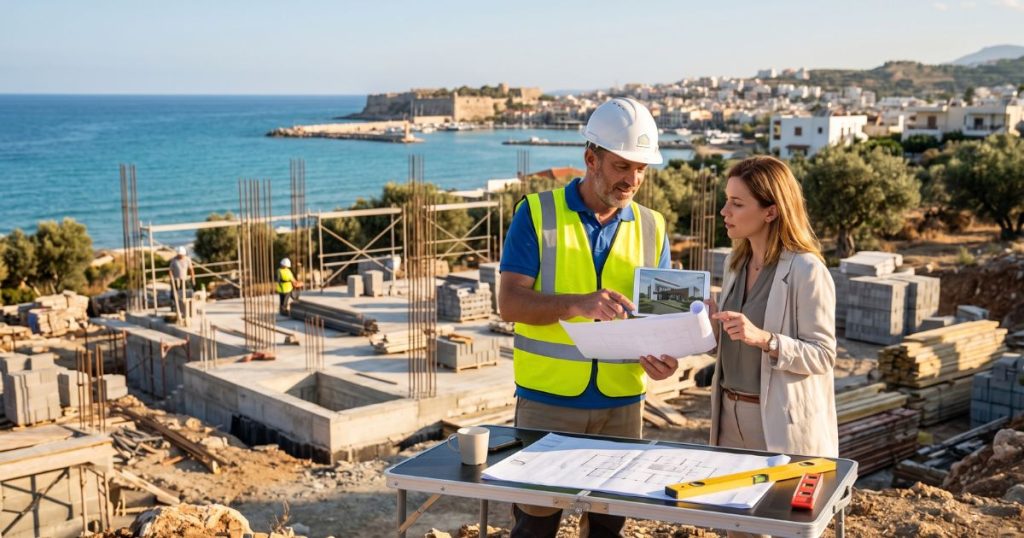
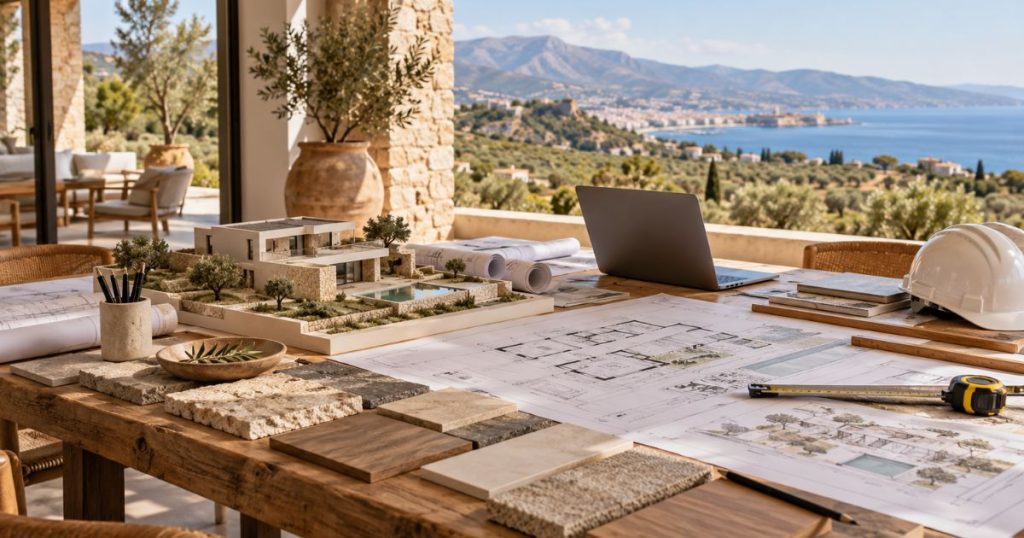
What does turnkey construction mean? See what it includes, what its advantages are and what to check before you award the project.
The term turnkey construction is used more and more often in the construction industry, especially for new homes, holiday homes and tourist properties.
But what does it mean in practice?
Put simply, it is a complete approach in which one company takes on the coordination of the project from the earliest stages to completion and handover to the owner.
The aim is that the client does not have to deal separately with dozens of different professionals and trades, but has one main partner and a single point of contact for the progress of construction.
For anyone planning to build a home in Rethymno or elsewhere in Crete, a turnkey solution can be particularly practical, especially when the owner does not live in the area permanently or wants to limit the time needed for day-to-day coordination of the project.
What exactly does turnkey construction mean?
The idea behind the word “turnkey” is that all you have to do at the end is turn the key.
When the project is complete, the owner receives a home that is ready to use.
Depending on the agreement, this can include:
- architectural and technical design,
- obtaining permits,
- planning and organising the work,
- construction of the load-bearing structure,
- masonry and insulation,
- electrical and plumbing installations,
- windows and doors,
- flooring and cladding,
- sanitary ware,
- painting,
- external works,
- final checks and handover.
However, the term “turnkey” does not always mean exactly the same thing from one company to another.
That is why it is essential to define clearly what exactly the quotation includes.
Turnkey does not always mean everything is included
A common mistake is to assume that a turnkey quotation automatically includes every possible task or piece of equipment.
In practice, some items may be included and others not.
For example, a quotation may fully cover the construction of the building but not include:
- furniture,
- electrical appliances,
- light fittings,
- landscaping,
- a pool,
- fencing,
- special outdoor works,
- connections to utility networks,
- certain designs or third-party fees.
So before an agreement is signed, there should be a detailed technical description that states clearly both what is included and what is excluded.
What are the main advantages of turnkey construction?
1. One point of contact
One of the biggest advantages is that the owner does not need to coordinate engineers, suppliers and trades separately.
There is one main person in charge, or a single team, that manages the project.
This can significantly reduce the complexity of the process.
2. Better coordination of the work
Building a home involves many consecutive tasks.
Electrical and plumbing installations must be coordinated with the masonry, windows with the finishes, insulation with the external cladding, and so on.
When one team handles the overall coordination, the risk of misunderstandings between different trades is reduced.
3. A clearer picture of the schedule
In a properly organised turnkey project there is usually an overall plan for how the project will progress.
The owner has a clearer picture of:
- the main stages of construction,
- the order of the work,
- the key decisions,
- the choice of materials,
- the expected handover.
This does not mean there can be no delays, but the project is managed more clearly as a whole.
Turnkey construction and the budget
The turnkey approach can also help keep better control of the budget, provided the quotation is properly organised.
The value is not simply in having one overall figure.
It lies in the owner being able to know:
- which materials have been provided for,
- which tasks are included,
- which choices can change,
- how additional work is costed,
- what happens if the design changes.
A very general quotation that simply says “turnkey construction” without a detailed description can leave a lot of room for misunderstanding.
What should a proper turnkey quotation state?
Before you decide, ask for as detailed a technical and financial description as possible.
Ideally, it should set out:
- the exact scope of the project,
- the technical specifications,
- the main materials,
- the categories of work,
- the exclusions,
- the schedule,
- the payment terms,
- the procedure for additional work,
- the procedure for changing materials or choices,
- how the project will be handed over.
The more is agreed before work starts, the less likely it is that disagreements will arise during construction.
Who is turnkey construction right for?
A turnkey solution can be particularly useful for owners who:
- don’t have time for day-to-day coordination,
- live in another town or country,
- want one main partner for the whole project,
- want construction to be better organised,
- want to limit their involvement in technical details.
In Crete, this is particularly important for owners of holiday homes or tourist properties who may live off the island or abroad.
In these cases, regular updates with photos, progress reports and scheduled meetings can be an important part of the collaboration.
Is turnkey construction more expensive?
There is no single general answer.
The final cost depends on the specifications, the materials, the size and complexity of the project and the range of services included.
Comparisons should therefore be made on the overall scope, not just on the final price.
A seemingly cheaper quotation may not include work that another proposal has already allowed for.
What matters is to compare services that are genuinely equivalent.
What should you look for before choosing a turnkey construction company?
The choice of company is decisive for the success of this kind of collaboration.
Before you go ahead, look at:
- the company’s previous projects,
- experience with similar projects,
- who will be the project manager,
- how supervision is carried out,
- how detailed the quotation is,
- how the schedule is monitored,
- how changes are costed,
- how the owner is kept informed.
A serious construction company in Rethymno or elsewhere in Crete should be able to explain the process clearly from start to handover.
Turnkey construction in Rethymno and Crete
Building a home in Crete often involves requirements that go beyond the building itself.
A project may include a pool, pergolas, retaining walls, landscaping, planting, outdoor kitchens or other special structures.
In addition, the shape of the plots, access and local conditions can significantly affect how the project is organised.
That is why a turnkey approach can offer a real advantage when the same partner has an overall view of both the building and the external works.
Frequently asked questions about turnkey construction
What does turnkey construction mean?
Turnkey construction is when one company takes full charge of managing and delivering the project, handing it over ready to use, in line with what has been agreed.
Does turnkey construction include the design?
It can, but that depends on the agreement. It should therefore be made clear whether the quotation covers only construction, or architectural, structural and other designs as well.
Are furniture and electrical appliances included?
Not necessarily. “Turnkey” does not automatically mean fully furnished and equipped. Everything should be described explicitly in the quotation.
Can I choose the materials?
Yes. The final materials are usually chosen at specific stages of the project, within the technical and financial specifications that have been agreed.
Conclusion
Turnkey construction can be a particularly practical solution for anyone who wants a more organised and complete construction process.
Its main advantage is that the owner works with one central partner who coordinates the different stages of the project.
However, the success of a turnkey project depends mainly on how clearly the specifications, work, materials, exclusions and schedule have been agreed.
That is why it is not enough for a quotation simply to say “turnkey”. It needs a detailed technical description and a clear agreement on exactly what will be delivered.
Planning to build a home in Rethymno or elsewhere in Crete?
Contact us to discuss the needs of your project and look at how a complete construction project can be organised, from the design to the final handover.